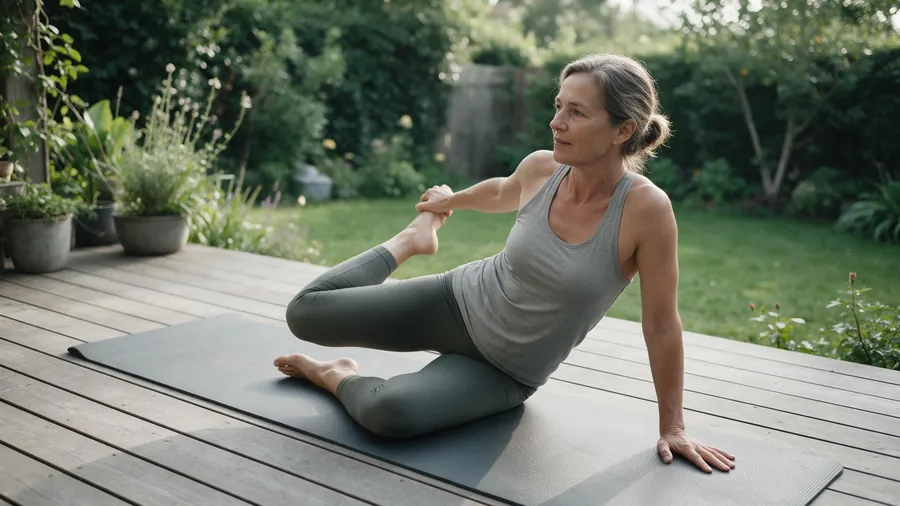
Stiff hips, shortened hip flexors, a back that will not cooperate in the morning: flexibility vanishes unnoticed. What sets mobility apart from stretching, which five joints count and how ten minutes a day bring years of freedom of movement.
In short
- Mobility is flexibility under control: the range you can use actively, not the one someone can push you into.
- Five joints decide: ankle, hip, thoracic spine, shoulder and wrist.
- Ten minutes daily with six exercises preserve and expand the range; stretching alone is not enough.
- Flexibility protects knees, back and shoulders, because neighboring joints otherwise take over the missing movement.
What mobility is
Stretching makes a joint passively more flexible: someone or gravity pushes it into a position. Mobility is the range you can reach and control actively, with the strength of your own muscles. The difference decides over injuries: a joint that goes far passively but is not stabilized actively is more injury-prone than a stiff one. That is why good mobility training combines stretching with strength at the end of the range.
The five joints
The ankle: whoever cannot get the knee over the toes without the heel lifting cannot do a deep squat and loads the knee wrongly. The hip: sitting shortens the hip flexors and lets the hip extensors waste away; the result is a back that takes over the work. The thoracic spine: it should rotate and extend but after years at a screen no longer does, and the lumbar spine and neck pay for it. The shoulder: the most mobile joint needs control overhead and behind the back. The wrist: underrated until push-ups or gardening hurt.
The daily routine
Ten minutes, ideally in the morning or before training. Ankle: knee to the wall, heel on the floor, ten times each side. Hip: deep squat with heels on the floor, hold 60 seconds, push the knees outward. Hip flexor: half-kneeling lunge with extended hip, 45 seconds each side. Thoracic spine: on all fours, one hand behind the head, rotate the elbow to the ceiling, ten times each side. Shoulder: open the chest on a door frame, 30 seconds, then circle the arms overhead under control. Wrists: on all fours, fingers pointing to the knees, sit back slowly.
Flexibility and age
Range of motion declines slowly from 30, but not through age, through disuse. Connective tissue adapts to use: whoever squats deep every day can still do it at 80, whoever does not loses it at 50. In Japan and in the Blue Zones old people sit on the floor and get up without hands; that is mobility training as a way of life. The sit-and-rise test, sitting down on the floor and standing up without hands, predicts mortality in studies.
Mobility and strength training
Both belong together: strength training through the full range, deep squats, deadlifts with a controlled hip, overhead presses, is mobility training in itself. Whoever combines both needs no yoga but may happily do it.
Try it
Fitness Age CalculatorResting heart rate, push-ups, one-leg stand, flexibility and grip strength: how old your body is functionally, in years.Heart Rate ZonesAge and resting pulse: your maximum heart rate and the five training zones after Karvonen, with zone 2 as the fat-burning range.Step CalculatorSteps, height, weight and pace: kilometers, calories, minutes and how much is missing to your daily goal.Frequently asked questions
Is yoga enough as mobility?
Yoga improves flexibility and control but does not cover all joints equally and replaces no strength training. As a complement it is excellent.
Should I stretch before sport?
Static stretching before training briefly lowers strength. Better: dynamic mobility exercises before, static stretching after or on separate days.
What helps stiff hips from sitting?
Stand up every 45 minutes, a one-minute deep squat twice a day and the half-kneeling hip flexor stretch. After four weeks the difference is clear.
This article is general information and not medical advice. If you have symptoms or existing conditions, or before changing any medication, talk to your doctor.
Share