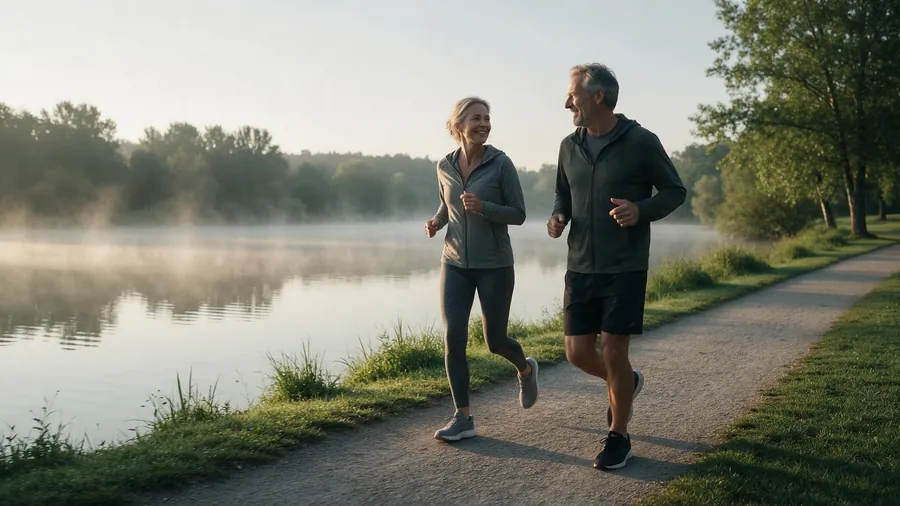
10,000 steps come from a Japanese advertising campaign, not from research. What the studies really say, from which number mortality risk falls, why pace counts and how to reach your steps without forcing it.
In short
- Mortality risk falls steeply up to about 7,000 to 8,000 steps, then the curve flattens; from 60 it is 6,000 to 8,000.
- Every increase of 1,000 steps lowers mortality by around 10 percent, up to saturation.
- Pace counts: 100 steps per minute is brisk, and 30 brisk minutes a day bring the largest benefit.
- Steps accumulate in daily life: walking errands, stairs, phone calls on foot, a walk after dinner.
Where the 10,000 comes from
The number comes from the 1960s: a Japanese manufacturer launched a pedometer called manpo-kei, which means 10,000-step meter. The number sounded round and became a world rule. Research has only checked it in recent years, with millions of measured days from step counters, and the result is more relaxed.
What the studies say
Mortality falls with every step, but not linearly: from 4,000 to 7,000 steps the risk falls clearly, between 7,000 and 10,000 a little more, above that hardly at all. For people over 60 saturation sits at 6,000 to 8,000, for younger people at 8,000 to 10,000. Every additional 1,000 steps lower mortality risk by about 10 percent up to that point. Whoever takes 3,000 steps today gains more with 6,000 than someone going from 10,000 to 15,000.
Pace counts too
Steps at a stroll count, but brisk ones count more. About 100 steps per minute corresponds to a brisk walk at which you can still talk; that is the lower edge of zone 2. Thirty minutes of it a day, so 3,000 of the 7,000 steps brisk, bring the largest additional effect on heart and blood sugar in studies. Uphill and with a backpack the effect grows further.
Collecting steps
Most steps come not from the walk but from the trips in between: get off one stop early, park at the far end of the lot, stairs instead of elevator, phone calls on foot, the walk to the bakery, a walk after lunch that additionally lowers blood sugar after the meal. A counter on the wrist or in the phone helps because the number becomes visible; a fixed time for a walk helps more.
Walking as training
For the untrained, older people and people with excess weight, brisk walking is the best endurance training: joint-friendly, without equipment, anywhere. Whoever wants more walks uphill, with a backpack or with poles, which activates the upper body. A daily walk of 30 minutes burns around 50,000 calories a year, that is seven kilos of fat, without a diet.
Try it
Step CalculatorSteps, height, weight and pace: kilometers, calories, minutes and how much is missing to your daily goal.Heart Rate ZonesAge and resting pulse: your maximum heart rate and the five training zones after Karvonen, with zone 2 as the fat-burning range.Calorie CalculatorHeight, weight, age, activity: your basal metabolic rate, your daily needs and the calories to lose, maintain or gain.Frequently asked questions
Do steps while shopping and at home count?
Yes, every movement counts for the overall benefit. For the heart effect, brisk continuous stretches of at least ten minutes count more.
Do steps replace strength training?
No. Walking preserves endurance and metabolism but no muscle mass and bone density in the upper body. Two strength sessions a week remain necessary.
How do I measure steps without a watch?
The phone in your pocket counts accurately enough. Or convert to time: ten minutes of brisk walking are about 1,000 steps.
This article is general information and not medical advice. If you have symptoms or existing conditions, or before changing any medication, talk to your doctor.
Share