Sixteen days, a renovated building and an anniversary: the Montreux Jazz Festival closed its 60th edition on 18 July with more than 250,000 visitors and an average occupancy of 91 per cent in its ticketed venues. In its closing statement the festival describes an edition pulled in two directions at once, a look back at six decades of history and a clear turn towards a new generation of artists.
Back in the Convention Centre
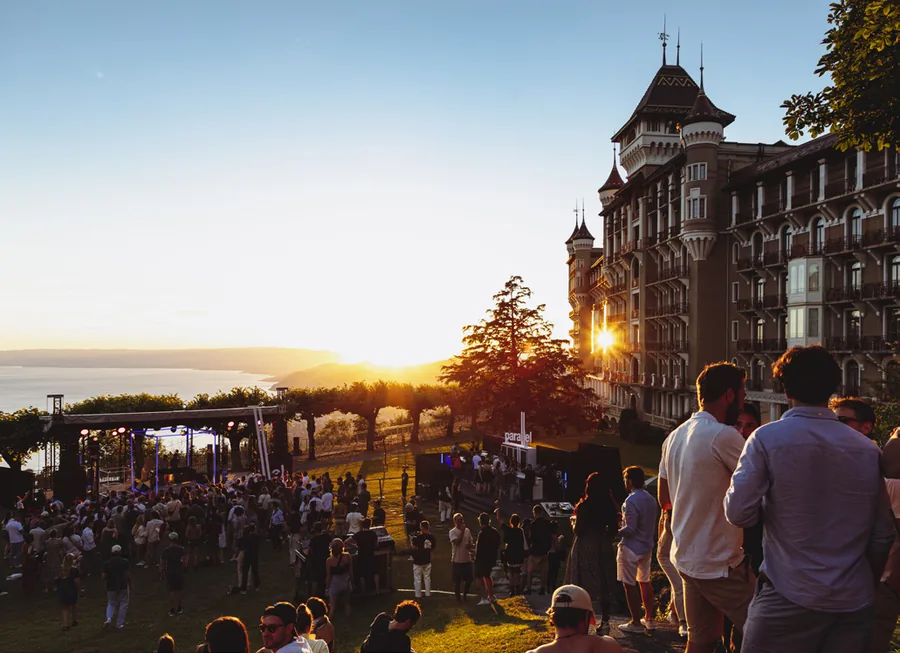
The 60th edition was the first major event in the Montreux Convention Centre since its renovation, and the festival calls it a full-scale test. Terraces, stairs and new spaces quickly became part of the route, circulation was smoother, and the new glass facades opened a view of the lake from the lobby of the Stravinski Auditorium that, by the festival's account, left many visitors amazed. Outside, the extended route along the quays drew people as far as the Spotlight and Super Bock stages at the eastern end; in Parc Vernex the Paloma added a terrace and a swimming area, and the Duplex made its debut as the new stage for electronic music.
An opening night built for the anniversary
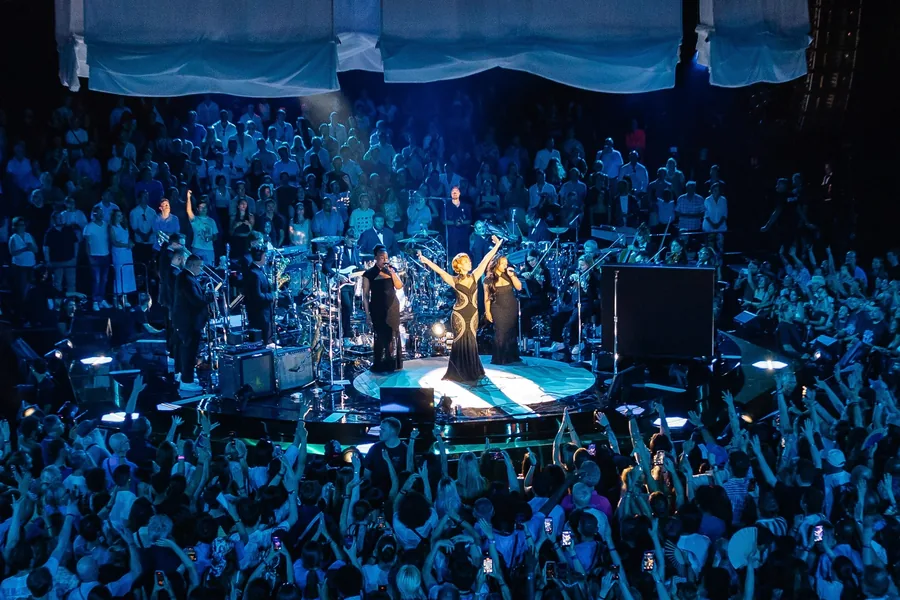
RAYE opened the festival with a show created together with Audemars Piguet. The Stravinski Auditorium was rebuilt around a rotating octagonal stage in the middle of the audience, with suspended sails carrying projections from the festival archive. For more than two hours she travelled through six decades of Montreux history, with tributes to concerts by Nina Simone, Prince, Aretha Franklin, James Brown and Ray Charles, before Mark Ronson and Alicia Keys appeared as surprise guests. Her own summary of the place: "Montreux Jazz is one of the last places left in culture that really cares about music."
The new generation, and the first legend
Much of the programme belonged to younger artists. Sienna Spiro marked the 50th anniversary of Nina Simone's famous Montreux concert and sang Autumn Leaves for the first time, eighteen months after playing to 200 people at the Spotlight Sessions in Villars; this time the Montreux Jazz Lab was full. Liniker brought thirteen musicians and the pianist Amaro Freitas, Ezra Collective stepped in at short notice after the Isley Brothers cancelled, and PinkPantheress, Conan Gray, Tyla and Zara Larsson drew a young crowd to the Stravinski that sang along in unison. Quieter evenings belonged to John Legend at the piano, Nick Cave with Into My Arms, Aldous Harding and Maro, while GIVĒON played his first concert in French-speaking Switzerland.
The close looked back. Marcus Miller paid tribute to Miles Davis, and Charles Lloyd returned 60 years after playing the very first edition in 1967; festival CEO Mathieu Jaton gave him an honorary award as the festival's first legend. Van Morrison and James Taylor shared the last night in the Auditorium, while Cerrone reworked his repertoire with an orchestra in the Montreux Jazz Lab.
Jam sessions and archive hours
Because the paid stages and the Lake House are now only a few steps apart, the late jam sessions flourished, with RAYE, Sienna Spiro, Naïka, Nectar Woode, Liniker and Dermot Kennedy among those who joined in. Leon Bridges, announced at the last minute, played a free concert at the Memphis to present his new album, and Adriatique played the Duplex. At the Lake House, talks and screenings brought the archive to life: Liniker spoke about music and political engagement through Montreux footage of Gilberto Gil and Ney Matogrosso, Tomoki Sanders saw film of his father Pharoah Sanders that he had not seen for nearly twenty years, and Marcus Miller commented on the Miles Davis archive. The exhibition Putting Montreux on the Map welcomed more than a hundred visitors a day.
On screens worldwide
51 concerts, three quarters of the ticketed line-up, were streamed live and free. By 16 July, before the last three nights, the recordings had passed 9.5 million views on YouTube and social media, led by RAYE, Zara Larsson and Moby. The Montreux Jazz Lab reached 88 per cent occupancy, its best result since it opened in 2013, and the festival met its ticketing target, the highest in its history in the usual format, by the second weekend. For more summer festivals worth a journey, see our festival calendar.